Shoes & Footwear
AI Product Photography for Shoes & Footwear on Shopify
Footwear shoppers can't try shoes on through a screen. They make the decision from photos — and if those photos don't show the color accurately, the sole thickness, the interior lining, and the way the shoe looks when worn, they either skip the purchase or buy and return. Footwear has the highest return rate in ecommerce: 30–40%. AI generates a complete 8-image set per shoe in 60 seconds for under $1, with no studio, no model, and no props to source.
By LinkedIn: Brian Chen • 9 min read• Published July 14, 2026

Quick Answer
Footwear Shopify stores average a 1.0–2.8% conversion rate — one of the lowest in ecommerce because the 30–40% return rate makes shoppers hesitate. Listings with complete image sets (8+ photos covering all angles plus lifestyle) convert up to 35% better than two-or-three-image listings. A 20-style footwear catalog shoot with on-foot lifestyle shots costs $12,000–$30,000 traditionally. AI generates the same 160 images for under $1 per product, in 60 seconds each, with no model booking and no studio.
Why Footwear Photography Is Different
Shoes have more mandatory angles than almost any other product category. A shirt needs a front and a back. A mug needs a side and a top. A shoe needs a side profile, a 3/4 front view, a heel close-up, a sole, an interior shot, and at least one lifestyle or on-foot image — and that's the minimum. Skip any one and a meaningful segment of shoppers won't buy.
Color accuracy is everything. The most common reason footwear shoppers return shoes is "not as pictured" — the tan leather reads brown on screen, the navy suede photographs as black, the white sole yellows under studio lighting. Color accuracy in photos directly determines whether the shoe that arrives matches what the shopper expected. AI renders colors from your product image accurately in every generated lifestyle scene.
Material texture matters. The difference between a $50 shoe and a $200 shoe is often invisible on a flat white background. Leather grain, suede nap, mesh ventilation panels, and rubber sole patterns read as identical under flat studio lighting. Close-up material shots communicate quality before the shopper reads the price tag. AI renders these textures accurately across every image type.
On-foot shots are the highest-converting image type — and the most expensive. Footwear shoppers want to see how a shoe looks when worn: the proportions on a real foot, the way the silhouette sits, whether the ankle cut hits high or low. Traditional on-foot photography requires a model ($150–$400/hour), a studio or location ($200–$600/day), and a stylist for the surrounding look. Prodofoto's On-Model mode generates photorealistic on-foot shots from your product image without any of this.
| Photography Challenge | Traditional Photography | AI Photography |
|---|---|---|
| 8+ mandatory angles per shoe | $75–$150 per pair for basic shots; full 8-angle set runs $200–$400 | All 8 angles generated in one session at under $1 total |
| On-foot lifestyle shots | Model $150–$400/hr + studio $200–$600/day + stylist — $1,000–$2,000+ per style | On-Model mode generates photorealistic on-foot shots from any product image |
| Color accuracy across materials | Color calibration adds post-processing time and retouching cost | AI renders color directly from the product image in every scene |
| Sole and interior views | Requires prop stand, specialized setup, separate shoot time | Generated as part of the same 60-second session |
| Multiple colorways of the same style | Full re-shoot per colorway — same cost multiplied | Each colorway generated in the same session at the same cost |
| Cost per style (full image set) | $500–$1,500 per style including studio, model, and post-processing | Under $1 for up to 9 lifestyle images per style |
Sources: Baymard Institute: Product Image Quality Research, Shopify: How to Take Great Product Photos
8 Image Types Every Footwear Listing Needs
Footwear shoppers ask more visual questions than shoppers in almost any other category. Each image below answers one of them. Miss an angle and a segment of potential buyers won't convert — they'll click elsewhere to find a listing that shows them what they need to know.
Side Profile Hero
The primary hero shot and the image that appears in search results. Full-length side view on a clean white or light grey background, centered, shoe facing right. This is the required primary image for Google Shopping, Amazon, and most marketplaces. Every other image in the gallery builds off this one.
3/4 Front Angle
Positioned at 45 degrees from the front — shows the toe box shape, the vamp, any overlays or details on the upper, and gives the shoe a three-dimensional read that a flat side profile can't. Shoppers use this image to assess the shoe's silhouette and fit profile before committing.
Heel Counter Close-Up
A tight shot of the heel counter, collar, and back seam. Shows stitching quality, heel cup reinforcement, and any branding or logo details. This is the trust-building shot for construction quality — the same visual cue that makes shoppers feel confident a shoe will hold its shape after 100 wears.
Sole Shot
Top-down view of the sole: tread pattern, rubber compound color, heel height, and any traction features. Required for athletic shoes and boots where sole specification is a purchase factor. Also answers the question shoppers can't ask: 'will this grip on wet pavement?'
Interior / Insole View
The interior lining, insole branding, and collar padding. Shoppers who care about comfort read this image before reading any spec sheet. For premium footwear, the interior shot communicates material quality (full-grain leather lining vs synthetic) that directly justifies the price point.
Material Detail Close-Up
A macro shot of the upper material: leather grain, suede nap texture, mesh weave pattern, or hardware finish. This image communicates quality at a tactile level — the image type most directly correlated with reducing 'not as pictured' returns for footwear.
On-Foot Lifestyle Shot
The shoe being worn in a relevant context: a running shoe on pavement, a dress shoe on an office floor, a sandal on a coastal path. This is the highest-converting image type for footwear — it answers 'how does this look when I wear it?' without any text. Traditional versions require a model; Prodofoto's On-Model mode generates these AI-free.
Lifestyle / Context Scene
The shoe in a styled setting that communicates the brand aesthetic: a Chelsea boot on autumn leaves, a sneaker on a polished hardwood floor, a sandal beside a beach bag. This image sells the lifestyle the shoe belongs to — the final emotional pull before Add to Cart.
AI Photography by Footwear Category
Different footwear sub-categories have different photography priorities. The shot that converts a running shoe buyer is not the shot that converts a dress shoe buyer. Here's what matters by product type.
Running & Athletic Shoes
Photography challenge
Mesh panels lose texture under flat lighting; midsole color and stack height are ambiguous without scale; action context is impossible without motion photography
AI approach
AI generates pavement running scenes, gym floor flatlays with fitness accessories, and close-ups of mesh ventilation texture and midsole foam — communicating performance without needing motion
Must-have shot
On-foot running context + sole traction detail + midsole close-up
Dress Shoes & Oxfords
Photography challenge
Leather grain requires precise lighting to read; patent leather reflects camera equipment; formal context is expensive to stage with appropriate wardrobe and location
AI approach
AI generates polished office floor scenes, desk and suit trouser context shots, and leather grain macro close-ups with studio-accurate lighting that doesn't reflect the camera
Must-have shot
Office/formal lifestyle scene + leather grain close-up + heel counter quality shot
Boots & Chelsea Boots
Photography challenge
Shaft height is unclear without a worn reference; suede nap photographs flat under harsh lighting; ankle profile differs significantly from side profile
AI approach
AI generates on-foot worn shots showing shaft height on leg, outdoor lifestyle scenes (autumn street, stone pavement), and suede texture close-ups with soft directional lighting
Must-have shot
On-foot shot showing shaft height + ankle profile + suede/leather material close-up
Sandals & Open-Toe Footwear
Photography challenge
Strap detail is the purchase driver but hard to photograph clearly; foot-shaped last can look abstract on white background; lifestyle context is critical for aspirational positioning
AI approach
AI generates beach and poolside lifestyle scenes, strap detail close-ups from above, and on-foot worn shots that show how straps sit across the foot
Must-have shot
Strap detail close-up from above + on-foot lifestyle in relevant setting
Casual & Lifestyle Sneakers
Photography challenge
Most competitive footwear category; lifestyle context is the differentiator between a commodity listing and a brand listing; colorways must each be shot separately
AI approach
AI generates street-style flat lays, coffee shop and weekend context scenes, and colorway comparison shots showing multiple variants in the same lifestyle setting
Must-have shot
Street or lifestyle context scene + colorway flat lay + side profile on clean surface
| Footwear Type | Must-Have Shot | Return Risk Without It |
|---|---|---|
| Running & athletic shoes | On-foot + sole traction + midsole close-up | High — performance buyers need sole spec and fit context |
| Dress shoes & Oxfords | Leather grain close-up + formal lifestyle scene | High — premium price requires visible quality proof |
| Boots & Chelsea boots | On-foot shot showing shaft height + material close-up | Very high — shaft height is the #1 source of fit surprises |
| Sandals & open-toe | Strap detail from above + on-foot in lifestyle setting | High — strap fit and foot coverage are invisible on white background |
| Casual & lifestyle sneakers | Lifestyle context scene + colorway comparison | Medium — context drives premium positioning vs commodity |
Sources: GrabOn: Ecommerce Product Photography Statistics, Google Merchant Center: Product Image Requirements
Before & After: The Visual Gap
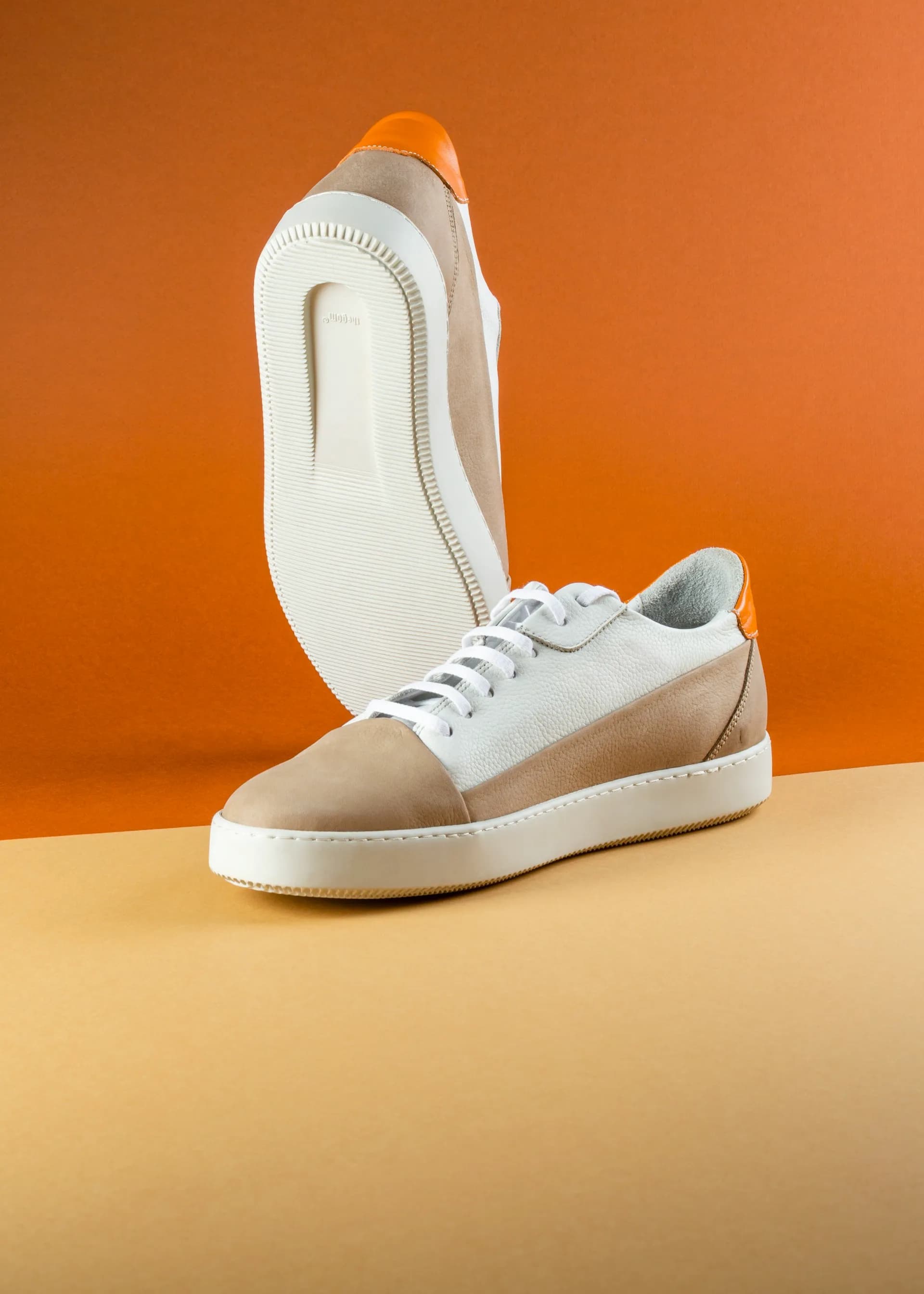
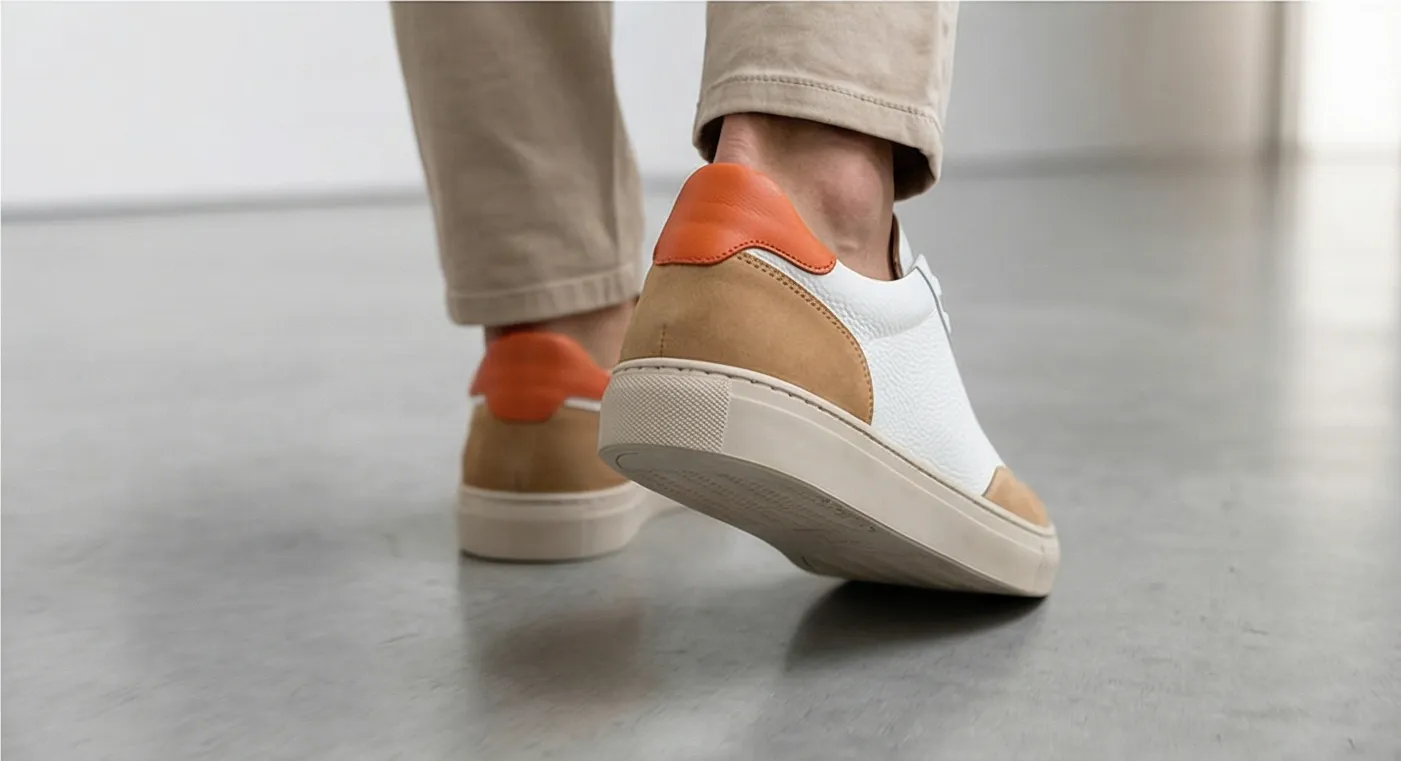
Footwear has one of the clearest before/after gaps in ecommerce. A plain white-background sneaker shot tells you the product exists and roughly what it looks like. The same shoe in a lifestyle context — pavement, natural light, casual outfit fragment — tells you who it's for and when to wear it. That answer is where the sale happens.
The sneaker below went from a clinical white-background studio shot to a full lifestyle context in one generation. Same product. The image on the right answers "what does this look like in my actual life?" without a word of copy.
How Footwear Brands Use Prodofoto
Prodofoto pulls your products directly from your Shopify catalog. No uploading files. No writing prompts. For a footwear brand with 40 SKUs, the workflow that used to require two days of studio shooting plus a model booking now takes under an hour.
Select your shoe from the Shopify catalog
Prodofoto connects to your Shopify store and shows your products. Pick the style you want to photograph. Your existing product images are already loaded — Prodofoto uses them as the starting point, so the generated photos show your actual shoe, not a generic stand-in.
Choose Lifestyle, Product-Only, On-Model, or Infographic
Lifestyle mode generates context scenes: pavement, hardwood floors, styled environments. Product-Only generates clean catalog shots for marketplaces. On-Model generates photorealistic on-foot shots — the highest-converting image type for footwear — without hiring a model. Infographic mode overlays feature callouts useful for athletic shoes with multiple technology features.
Generate up to 9 photos in 60 seconds
One click generates multiple unique variants: different angles, different environments, different lighting contexts. You get a full image set, not a single shot — giving you options for the main gallery, secondary lifestyle images, and seasonal refreshes.
Edit until the color and material detail is right
If a generation renders the shoe in slightly the wrong shade or misses a sole detail, use Prodofoto's natural-language editing to adjust. 'Make the leather more cognac and show the sole tread' updates the scene without starting over. Color accuracy is critical for footwear to prevent 'not as pictured' returns.
Publish directly to your Shopify product listing
One click publishes the image directly back to the Shopify product page. No downloading, no re-uploading, no manual file management. For a footwear brand, this means going from a single white-background shot to a complete 8-image gallery without leaving the Shopify admin.
A footwear brand with 40 styles would traditionally need two days of studio shooting with a model at $3,000–$6,000 per day, plus post-processing. With Prodofoto: 40 styles × 9 photos each = 360 lifestyle images, at under $1 per style. No model. No studio. No returns from images that didn't show what arrived. See the full cost breakdown.
Turn One Shoe Photo Into a Full 8-Image Gallery
Prodofoto generates up to 9 lifestyle images per shoe in 60 seconds. Side profiles, on-foot shots, lifestyle contexts, material close-ups — all from your existing Shopify catalog. Under $1 per style. No model booking. No studio.
Frequently Asked Questions
Can AI product photography handle different shoe materials like leather, suede, and mesh?
Yes. AI product photography renders leather grain, suede nap, mesh panels, metallic hardware, and rubber soles with studio-quality accuracy. The key is starting with a clean product shot on a white or neutral background — the cleaner the input, the more precise the material rendering in generated scenes. AI handles the material-specific lighting (soft diffuse for suede, sharp reflection for patent leather) in the output scene.
How many product photos does a shoe listing on Shopify need?
Plan for 8–10 images per shoe: a side profile (the primary hero), a 3/4 front angle, a heel counter close-up, a sole shot, an interior lining view, a toe box close-up, a lifestyle scene showing the shoe being worn, and a flat lay grouping if you sell pairs. High-ticket footwear ($100+) benefits from a ninth shot showing material detail — leather grain, stitch quality, or hardware finish. Each angle answers a specific question shoppers ask before purchasing.
How much does traditional footwear photography cost?
A professional shoe photoshoot costs $75–$150 per pair for basic white-background shots. Add on-foot lifestyle shots with a model and you're looking at $300–$600 per style, plus model fees ($150–$400/hour). A footwear catalog of 20 styles — each needing 8 images including lifestyle and on-foot — runs $12,000–$30,000 in traditional photography. AI generates the same 160 images for under $1 per product, in 60 seconds each.
How do I show the interior lining and insole of a shoe with AI product photography?
Prodofoto generates interior and insole views from your existing product images. The Lifestyle mode places shoes in contexts where the interior reads naturally — an open shoe with the tongue pulled back, a flat lay angled to reveal the insole. The Product-Only mode generates clean, clinical interior shots on white for marketplace requirements. If the first generation doesn't show the interior clearly, use Prodofoto's natural-language editing to specify 'show the interior lining with the shoe propped open at 45 degrees.'
Can AI generate on-foot lifestyle shots of shoes without hiring a model?
Yes. Prodofoto's On-Model mode generates photorealistic on-foot shots of your shoes without hiring a model or booking a studio. The shoe appears naturally worn by an AI-generated model in a relevant lifestyle context — a running shoe on pavement, a dress shoe on a polished floor, a sandal on a beach path. This is the image type that most directly answers 'how does this look when worn?' and drives the conversion for footwear listings.
How does better shoe photography reduce the 30–40% return rate for footwear?
Most footwear returns happen because the shoe looks different than the listing photo — wrong shade, unexpected finish texture, unclear sole thickness. Complete image sets (side, heel, sole, interior, on-foot) reduce the 'not as pictured' return driver by showing exactly what arrives. Accurate color rendering in lifestyle scenes, close-ups showing material quality, and scale reference shots set accurate expectations before purchase. Stores with 8+ images per shoe listing typically see return rates 15–25% lower than listings with 2–3 images.
Can Prodofoto generate footwear photos for my entire Shopify catalog at once?
Yes. Prodofoto pulls products directly from your Shopify catalog — no manual uploading. Select any shoe or boot, choose a shoot mode (Lifestyle, Product-Only, On-Model, Infographic, or Copycat), and generate up to 9 photos per product. For a footwear brand with 40 SKUs, generating a complete lifestyle and on-model set takes under an hour at under $1 per product. One click publishes each image directly back to the Shopify product listing.
References
- Shopify: How to Take Great Product Photos (Step-by-Step Guide)
- Baymard Institute: Product Image Quality and Zoom Research
- GrabOn: Ecommerce Product Photography Statistics 2026
- Google Merchant Center: Product Image Requirements
- Statista: Global Footwear Market Overview
- BigCommerce: The Complete Guide to Product Photography
- EasyApps: Shopify Conversion Rate by Industry 2026
Keep reading